of Life
Episode 2 7:07
Why Letting Anger Out Makes It Worse (and the One Second That Matters)
You present three months of work. A colleague turns to your boss and says, loud enough for the whole room: "An intern could do this in a week." Your boss laughs. Eight words. At ten that night you are still awake, writing a reply to a man who is asleep.
Thai version: ทำไมยิ่งระบายความโกรธ ยิ่งโกรธ (และหนึ่งวินาทีที่เปลี่ยนทั้งคืน)
Script
It is ten o’clock at night. The lights are off, the pillow is cool, and you are wide awake, writing a speech. It is a very good speech. It is sharp, it is fair, and the man it is meant for will never hear it, because he is across town, asleep. All of this began seven hours ago, with eight words. And somewhere in those seven hours, there was one second when the whole evening could have gone another way. To find it, we go back to three o’clock.
Three in the afternoon. You have just presented three months of work. Your evenings. Your weekends. And a colleague turns to your boss and says, loud enough for the whole room: An intern could do this in a week. Your boss laughs. The meeting moves on. But something has already happened in you. A flash of heat in the chest. A tightening in the jaw. And notice the order. The heat came first. The thought, he just humiliated me, came after. That is how we are wired: the alarm rings before the thinking brain has finished its sentence. So the first flash is not a choice, and it is not a weakness. What matters is the second after it.
Five past three. Back at your desk, a friend who saw it all leans over and says, kindly: Let it go. He’s not worth it. And here is something strange. Now you are annoyed at your friend. Think about that. Nobody guards a toothache. Nobody feels robbed when a headache is taken away. Anger hurts, and yet when someone offers to take it from us, we hold on. Why would we protect something that hurts?
In 2004, researchers in Zurich put volunteers in a brain scanner and had them play a game of trust, for real money. Sometimes the other player betrayed them and kept everything. Then the volunteer had one minute to decide: punish him, or not? Punishing cost the volunteer money too, and brought nothing back. Most of them paid. But the telling part was the scan during that minute. Before any punishment had happened, a reward centre lit up, the same kind of circuit that answers to food we love or money we win. The brain was handing out the sweetness of revenge in advance.
The Buddha put it in four words. Asked what one should destroy in order to sleep at ease, he answered: anger, with its poisoned root and its honeyed tip. Nobody bites the root. We lick the tip. And the honey has a very particular taste. It is the taste of being right. A moment ago you were made small in front of the room. Anger hands you a suit of armour and a judge’s chair. In the court inside your head, you win every case. That is what your friend was trying to take away.
Half past five. You are still angry, so you do what everyone says to do. Let it out. You go to the gym and hit the heavy bag, and you picture his face on it. In 2002, the psychologist Brad Bushman tested exactly this. He had six hundred students insulted about an essay they had written. One group then hit a punching bag while thinking about the person who had insulted them. A second group hit the bag while thinking about getting fit. A third group just sat quietly for two minutes. Then all of them got the chance to blast that person with loud noise. Now guess. Which group was the gentlest? The ones who had vented at the bag were the angriest, and the most aggressive. The ones who had done nothing at all were the calmest. A later review of a hundred and fifty-four studies found the same. Letting it out is not opening a valve. It is working the bellows.
Half past six. Dinner, and you do not hear a word anyone says. Nine o’clock. The shower, where you win the argument four more times. And so, ten o’clock. Here is the bill. The Buddha once asked: what would your worst enemy wish for you? That you look worn. That you sleep badly. That your judgement fails. That you lose what you have earned, lose your good name, and that your friends drift away. An enemy can wish all this. He cannot easily do it. But an angry person, the Buddha said, does every item on that list to himself. Your colleague has been asleep for an hour. He paid nothing. You are paying for both of you.
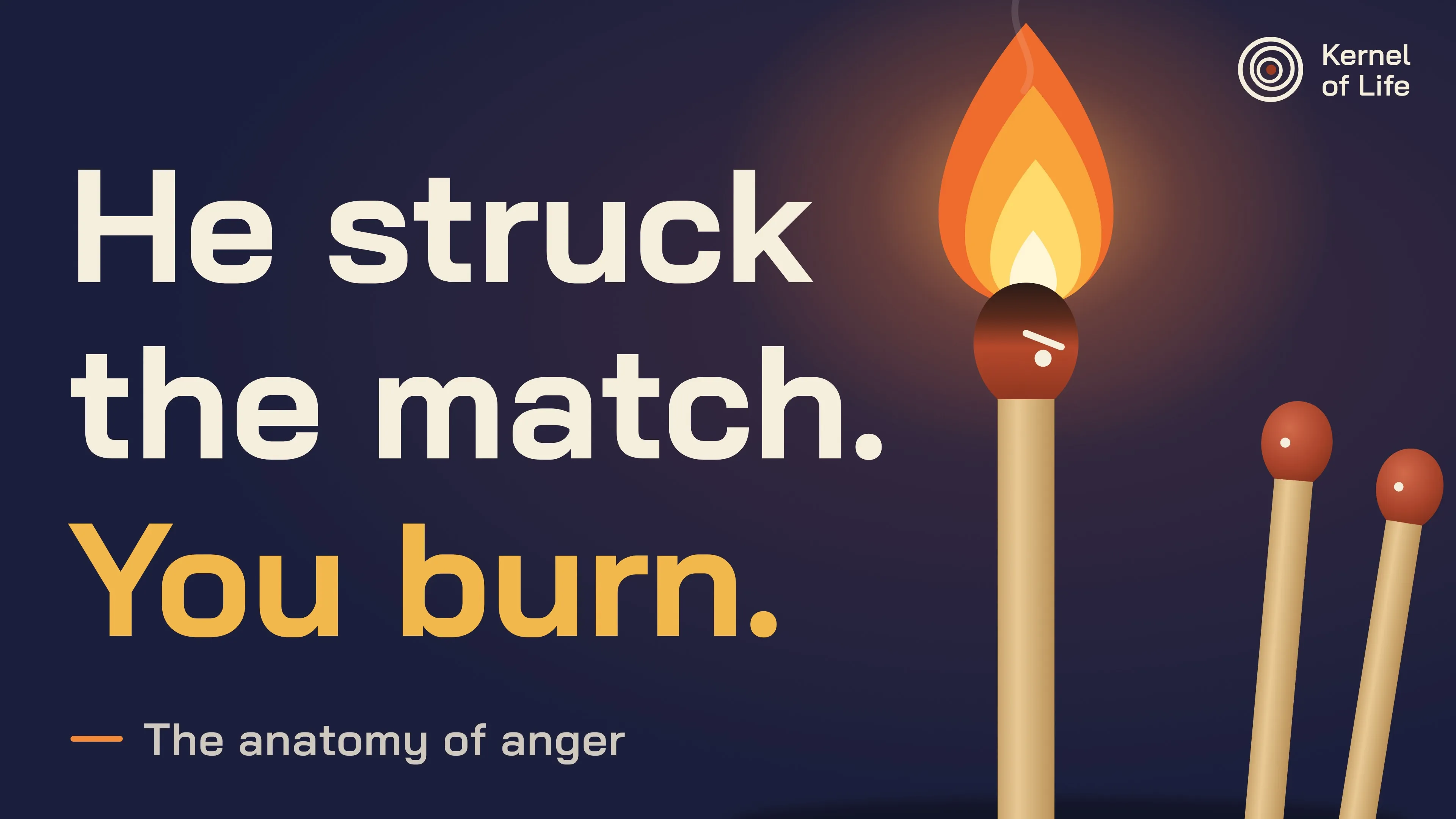
So what does work? There is an old story about this. A man famous for his temper once came to the Buddha and abused him to his face, at length. The Buddha waited until he had finished, and then asked a question. When guests come to your house, do you offer them food? Of course, said the man. And if they do not accept it, whose food is it? Mine, said the man. It stays with me. Just so, said the Buddha. What you have offered me, I do not accept. It is yours. Think of an insult as a parcel at your door. Hearing the doorbell is not the same as signing for it. Eight words arrived at three o’clock. You have carried them for seven hours. But you never had to sign.
The next day. Three o’clock. Same room. You present again, and the same colleague says: Careful. The intern is waiting. And the flash comes, exactly as before. But this time you see it arrive. Heat. Jaw. There it is. That is the first second: you look at the heat, not at him. Then the camera steps back. Two people at a table, one of them performing for the boss. The parcel sits at the door, unsigned. One long breath out, and the shoulders drop. It looks like doing nothing. It is what the calmest group did. And because you are not busy building a case, your voice is steady when you say, in front of everyone: If there is a problem with my numbers, name it. If not, let me finish. The room goes quiet. He looks down at his notes. This is not being a doormat. It is the firmest thing you have said all year, and your hands did not shake. And at ten o’clock that night, you are asleep.
The first flash belongs to nature. Nobody gets to skip it. What happens in the second after it is the part that is yours. So tonight, when you lie down, it is worth asking one question. Whose words are you about to give your pillow to?