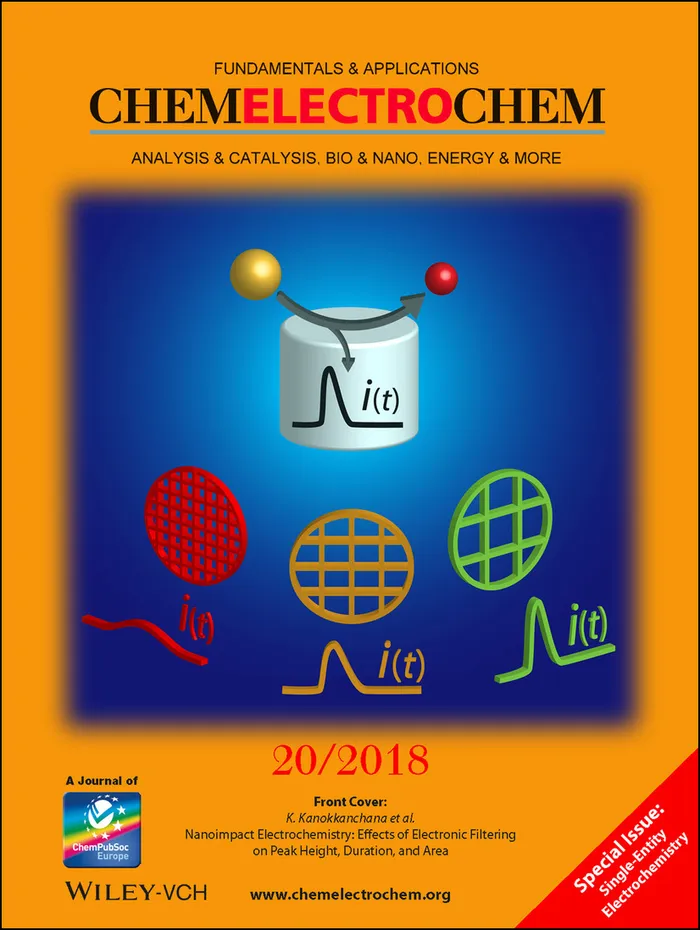
Nano Impact Electrochemistry: Effects of Electronic Filtering on Peak Height, Duration and Area
ChemElectroChem 2018, 5, 3000–3005. doi:10.1002/celc.201800738
Research
A rotating-disk electrode reports one number for billions of particles. Per-particle measurements reveal the champions the average conceals — but only if the instrument can see them. My work spans the methods, the hardware and the software needed to do so, and then takes the same instruments out of the laboratory.
Part I · Analytical chemistry at the nanoscale
In nano-impact electrochemistry a single silver nanoparticle strikes a microelectrode and its oxidation appears as a sub-millisecond, picoampere current spike — one particle, one spike. Every commercial potentiostat we tested either buried that spike in noise or smeared it beyond recognition: their filters distort exactly the signal the experiment needs.
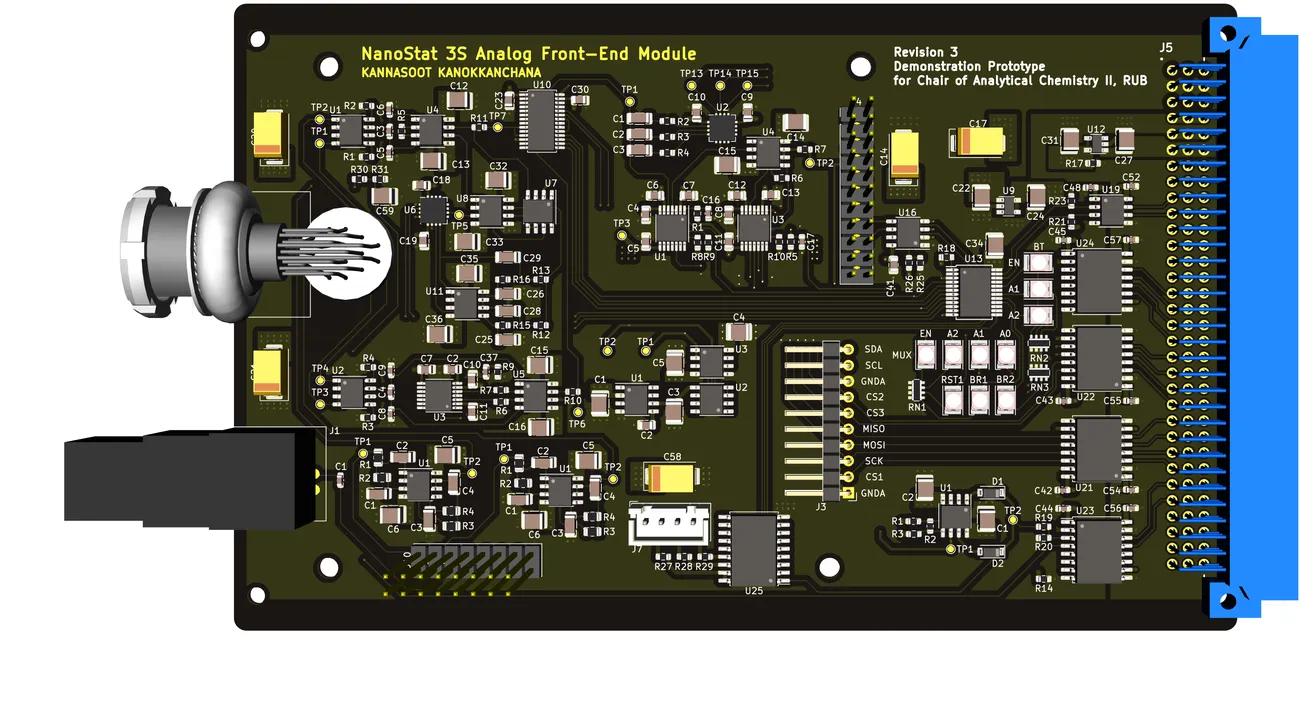
So I built the measurement chain myself — a 500 MΩ head stage, 8-pole Bessel filters, 18-bit conversion at 200 kHz, and my own acquisition software — and then modelled the entire chain as an electronic circuit to understand precisely how filtering reshapes peak height, duration and area. Because we built everything, we understand the system completely, and that understanding travels: the same methods measured ion diffusion coefficients within 6% of literature, decoded ion solvation in water–alcohol mixtures, and sized shape-controlled nanoparticles to TEM accuracy.

ChemElectroChem 2018, 5, 3000–3005. doi:10.1002/celc.201800738
The Journal of Physical Chemistry Letters 2022, 13, 10120–10125. doi:10.1021/acs.jpclett.2c02720
ACS Catalysis 2021, 11, 5318–5346. doi:10.1021/acscatal.0c04118
ChemElectroChem 2022, 9, e202101435. doi:10.1002/celc.202101435
Part II · Field-deployable instrumentation
The nanoscale laboratory taught me what a potentiostat has to get right. The next question was whether the same instrument could be made small, rugged and simple enough for a non-specialist to use outdoors — and cheap enough to build by the hundred.
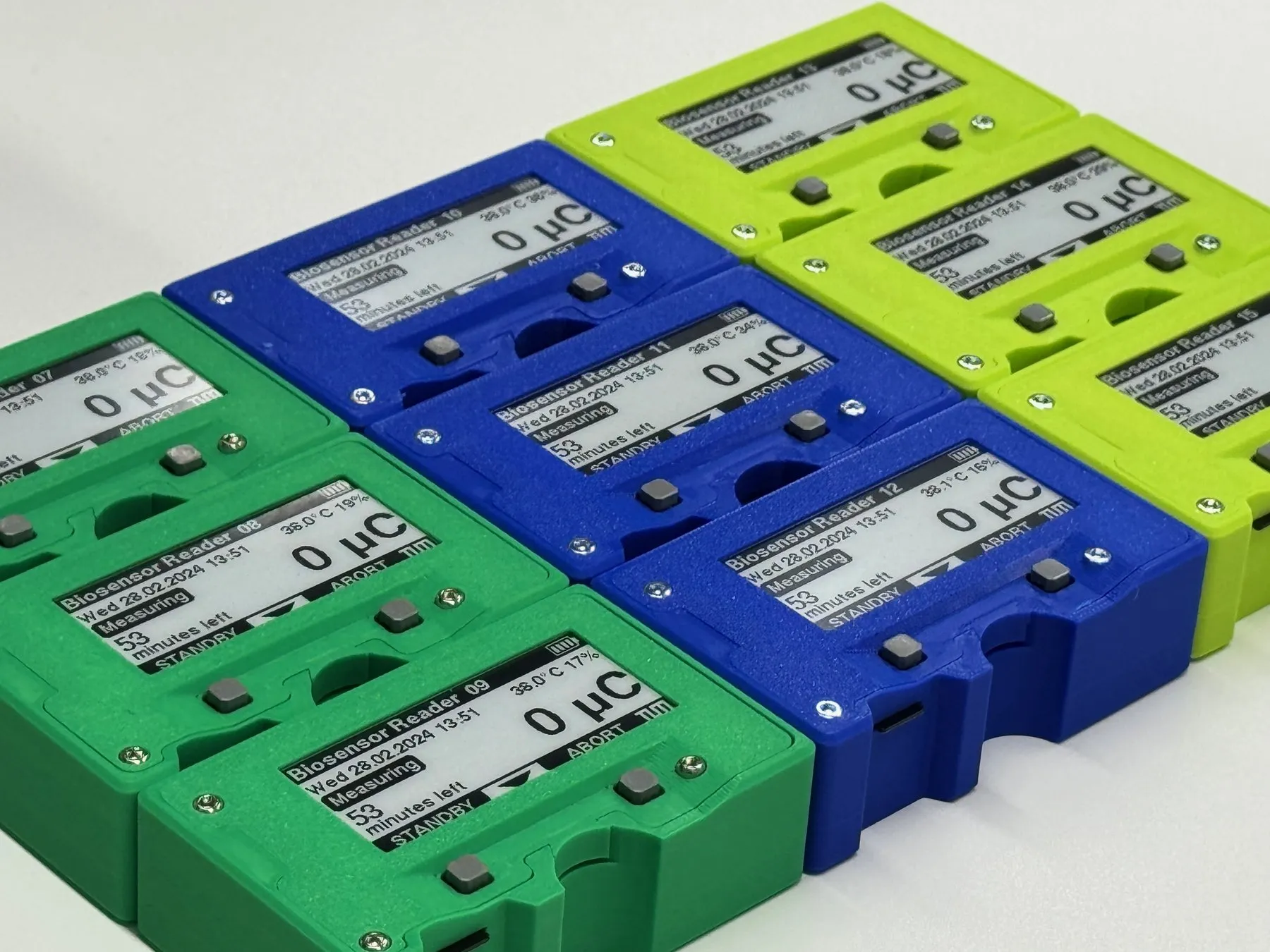
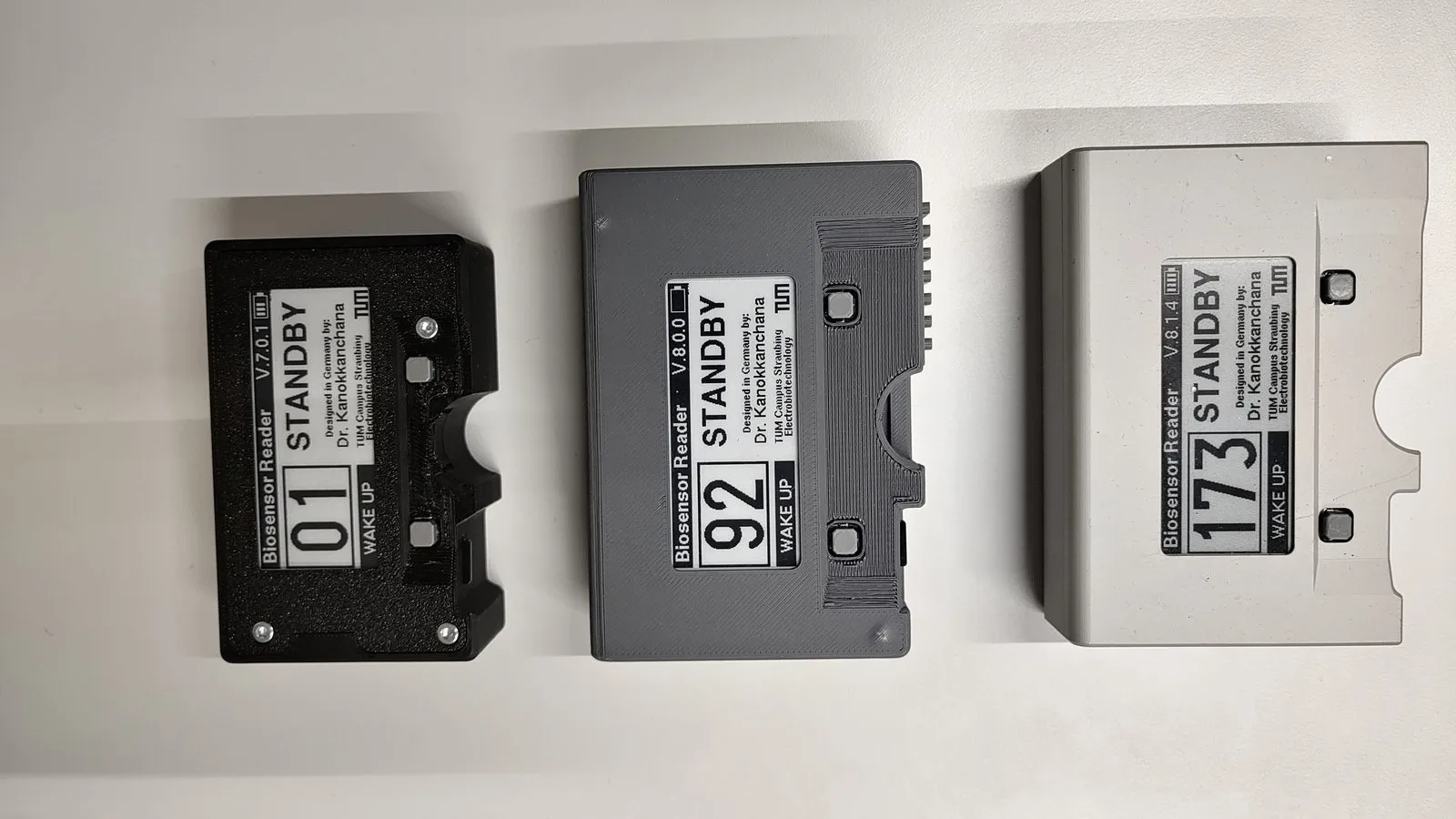
The handheld potentiostat is the answer: a complete instrument developed from a blank schematic — analogue front end, digital acquisition, power management, firmware and enclosure — every piece designed, built and calibrated in-house, and its manufacturing planned and managed from the first batch to the last. Three generations followed in three years: one proof-of-concept unit in 2023 that already beat the commercial reader it replaced at a tenth of the cost; a fleet of 36 field-ready units in 2024 with a heated measurement chamber regulated to ±0.1 °C and an all-day battery; and 200 production units in 2025 — enclosed sensor chamber, machined aluminium housing.
In its first application the instrument read disposable enzymatic sensor strips developed by colleagues, outdoors and in non-specialist hands. The electronics do not care which chemistry is on the strip: the same platform serves agriculture, water monitoring, point-of-care health and food analysis.
Part III · Machine learning in sensing
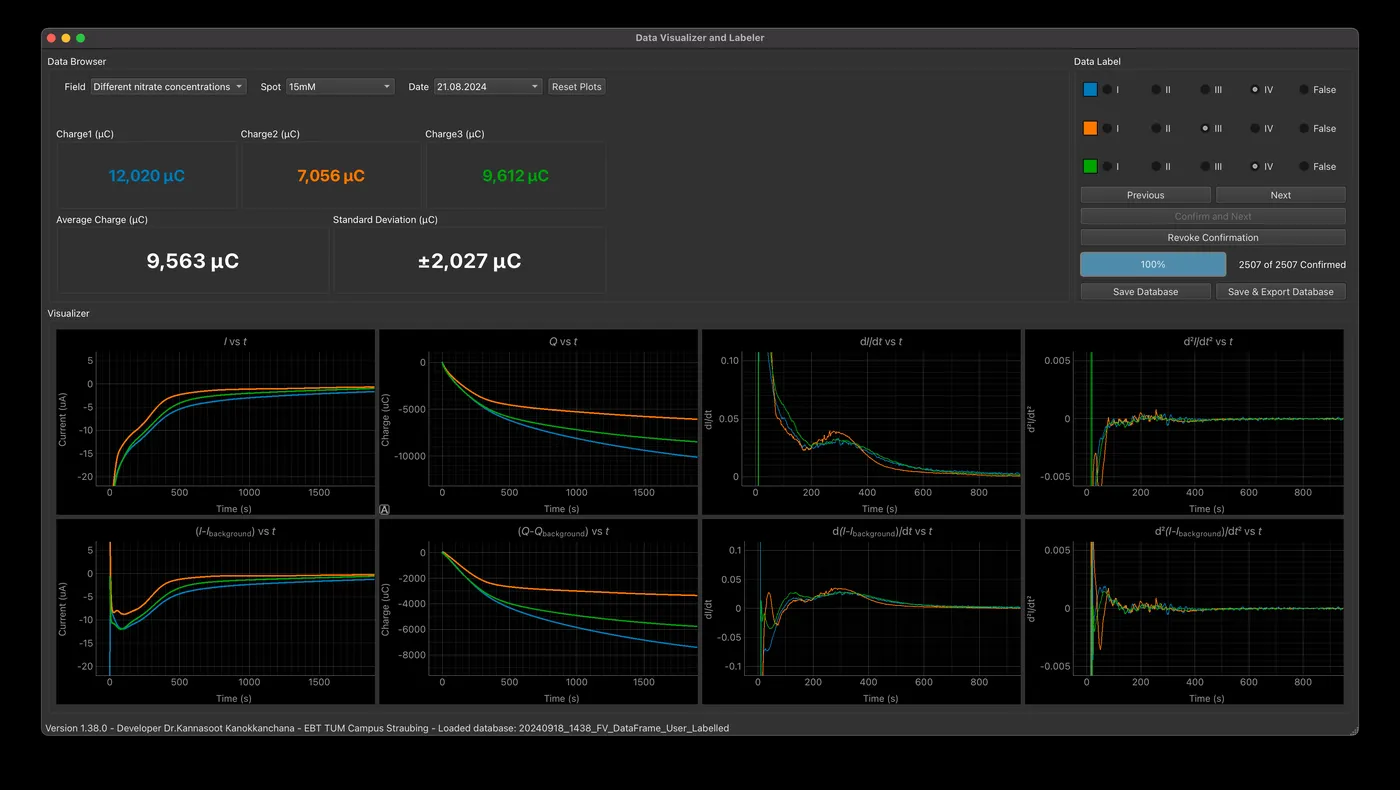
Hundreds of instruments in the field produce thousands of chronocoulometry curves. I wrote the multi-channel visualiser that batch-processes them all — and then trained a one-dimensional convolutional network on real field transients. It watches the first minutes of a measurement and predicts the endpoint, cutting measurement time roughly six-fold with zero change to the hardware.
Software and algorithms are instruments too.