of Life
Episode 17 7:03
10 Stoic Lessons for the Longest Night
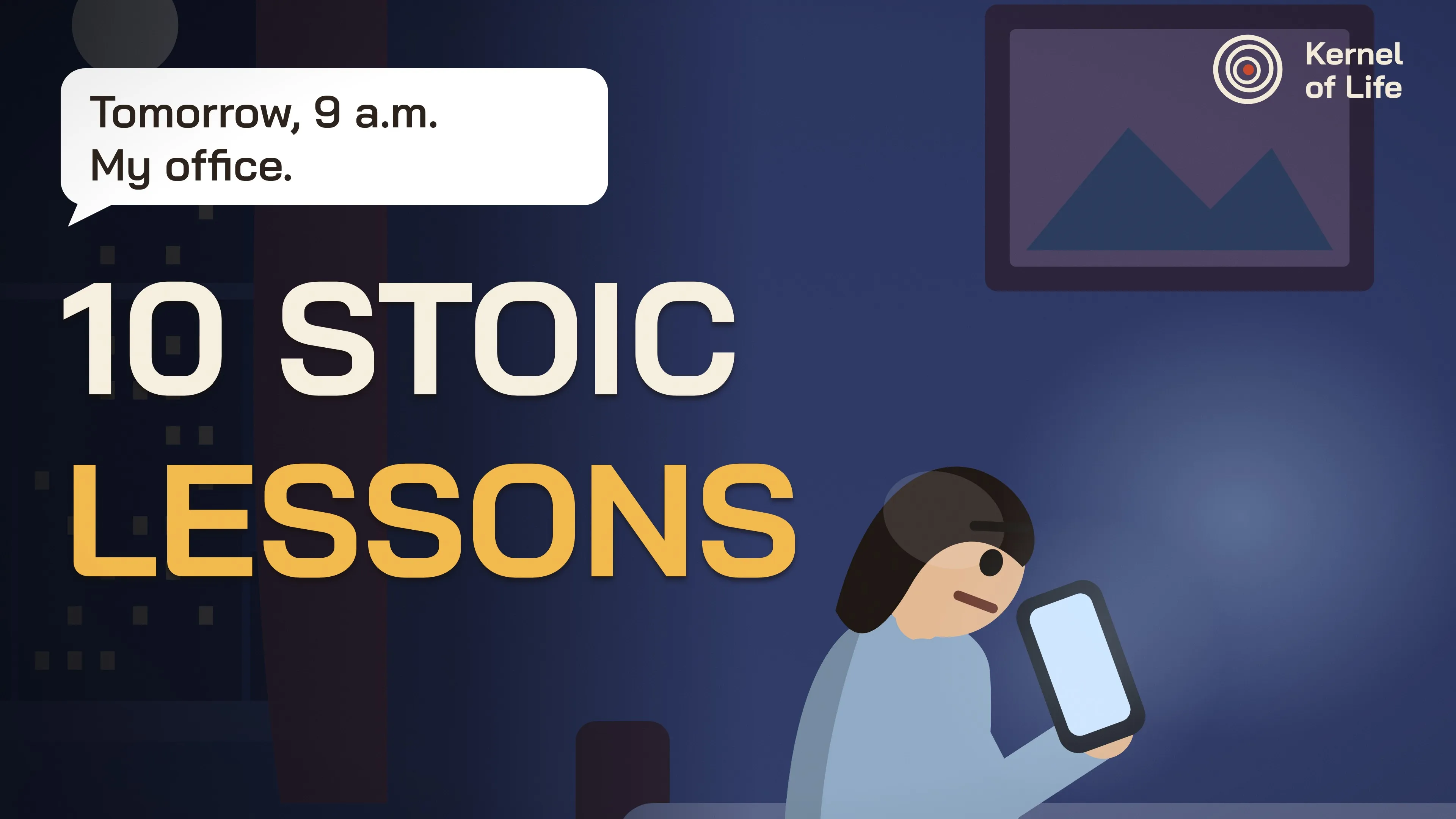
“The greatest obstacle to living is expectancy: it hangs on tomorrow and loses today.” Seneca wrote that almost two thousand years ago. It's late, and your boss has sent one line: “Tomorrow, 9 a.m. Come to my office.” Nothing more. This film takes you through that night with 10 Stoic lessons from Seneca, Epictetus, Marcus Aurelius, Cato and Zeno, the founder of the Stoic school, counting down from 10 to 1, the most important.
Thai version: สโตอิก 10 ข้อ สำหรับคืนที่นอนไม่หลับ
Script
The greatest obstacle to living is expectancy: it hangs on tomorrow and loses today. Seneca, a philosopher of Rome, wrote that almost two thousand years ago. It’s late. Your phone buzzes. One line from your boss. Tomorrow, 9 a.m. Come to my office. Nothing about what. And the whole night is about to vanish into waiting. Seneca and his fellow Stoics left ten lessons for nights like this. Let’s count them down, all the way to 9 a.m.
Number ten. Your brain starts writing your boss’s lines for him. Scene one: you’re fired. Scene two: you’re torn apart in front of the whole meeting. Scene three: security carries your box out to the street. And none of it has happened. Seneca, adviser to the emperor Nero, wrote to a friend: we suffer more often in imagination than in reality. Tonight you’ve been fired three times. In reality, not once.
Number nine. You read the message for the seventeenth time. No “please.” So he must be angry. Now read it in your boss’s voice on a good day. Tomorrow, 9 a.m. Come to my office. Word for word the same, and nothing frightening about it. Epictetus, a Stoic teacher who had once been a slave, taught that it isn’t things that disturb us, but our opinions about them. The message is only words. The angry tone, you added yourself. So why are you still awake?
Number eight. You type into the search bar: signs you’re about to be fired. Twenty-three threads later, a whole hour has simply gone. Seneca again. He wrote: life is not short; we make it short. People guard their money as if it were their lives, yet hand out their time to anyone who asks. Tonight, nobody even asked. You gave it away yourself. Put the phone down.
Number seven. The real fear finally shows up. If I lose this job, what will I eat? Seneca was one of the richest men in Rome, yet he advised practicing poverty. For three or four days, eat the cheapest food, wear the roughest clothes, and ask: is this the condition that I feared? You open the cupboard and find the last packet of noodles. You cook it in the middle of the night. It tastes better than you expected. A fear the size of a tower shrinks to the size of a bowl. And you fall asleep.
Number six. It’s morning. Before you get out of bed, try what an emperor did. Marcus Aurelius left himself a reminder: say to yourself in the morning, today I will meet the busybody, the ungrateful, the arrogant, the deceitful, the envious and the unsocial. So that when you do meet them, you need not be angry. As for you, today you may meet a frowning boss. Noted.
Number five. Your favorite coffee mug slips from your hand and shatters across the floor. The one a friend gave you in your first year at work. Epictetus taught: if you love a cup, remind yourself that what you love is a ceramic cup, and cups break. Then when it breaks, your heart won’t break with it. You sweep up the pieces and run for the train.
Number four. Someone bumps your arm, and your fresh coffee spills down your white shirt. Forty minutes until you face your boss, and the whole train car is staring. Cato, a Roman senator, used to walk out into the street barefoot, without a tunic, letting people stare, to train himself to be ashamed only of what is truly shameful. A coffee stain is nothing to be ashamed of. You stand up straight and keep walking.
Number three. Your boss says the client has cancelled the project. Three months of your work, over. None of the scenes you rehearsed. Then he adds: if the slides had been better, maybe this wouldn’t have happened. Heat rises to your face. The perfect comeback is on the tip of your tongue. Seneca tells how Plato, angry with his slave, raised his hand to strike him, then realized he was angry and froze with his hand in the air. A friend asked what he was doing. Plato said: punishing an angry man. Seneca’s verdict: the greatest remedy for anger is delay. You swallow the comeback and ask for ten minutes.
Number two. You stare at three months of work, sunk without a trace. Like a merchant twenty-three hundred years ago. Zeno filled a ship with costly purple dye, and the ship went down off Athens. The whole cargo, lost. He walked into the city, sat in a bookshop and read about Socrates. Then he asked the bookseller: where can I find men like this? The bookseller pointed at a philosopher passing by. Follow that man. And Zeno did. Later he taught under a painted porch called the Stoa. That’s where the word Stoic comes from. He is said to have looked back and said: I made a prosperous voyage when I suffered shipwreck. Your ship just sank. Where’s your bookshop?
Number one, the most important. There’s a story that when Epictetus was a slave, his master twisted his leg for fun. Epictetus smiled and said calmly: you will break my leg. His master twisted harder. The leg broke. Epictetus said: did I not tell you? Whether it really happened, nobody knows, but he did walk with a limp. His master could break his leg. Whether he raged or panicked, the master could not choose for him. So the first line of his handbook says: some things are up to us, and some are not. The client cancelling: not up to you. Your boss’s words: not up to you. The ten minutes you asked for: all yours. All nine lessons before this one are this lesson, in different clothes.
The tomorrow you waited for all night is now today. Don’t lose it waiting for another tomorrow. You don’t need all ten. Pick one. But there’s one more thing that isn’t up to us, one people tend to overlook. Take a guess. Our own body. Epictetus put it first on that list. More than five hundred years before him, an eighty-year-old king told a monk: sometimes I mean to put my foot here, and it lands somewhere else. That story is in our film The Root of Suffering.